
Investigating Rogue Trader, Part 1
In the grim darkness of the 41st millennium, there are only talents and skills.

My personal history with the grim darkness of the far future is a little more than a decade long. I first learned about warhammer 40k from a buddy in high school as we poured over the pages of a 7th edition Imperial Guard codex. This would have been around 2014. I went through a phase wherein I aspired to actually collect one army or another but it’s clear to me now even in 7th edition I had already missed the glory days of the hobby. I have been thoroughly withdrawn from 40k for five or so years now.
Recently a youtuber I enjoy called Warlockracy, who makes excellent long form reviews of millennial-nostalgia era video game CRPGs, put out a video on Owlcat Games’ Rogue Trader. I felt myself being drawn back in to 40k for the first time in quite a while watching it, and ended up pausing the video the play the game myself as it was currently on sale on steam. I did this against my better judgement, as I loathed Owlcat’s previous pathfinder RPGs for a litany of reasons too long for this article.
While Rogue Trader manages to evoke the grim and dark aesthetic and thematic trappings of Warhammer 40,000 well enough the gameplay leaves something to be desired. I believe videogames and tabletop roleplaying games have been engaged in some form of feedback loop death spiral for at least 3 decades now. The problem with Rogue Trader is that it is fundamentally, like all videogame RPGs, a story about literally 6 people travailing around to personally solve every problem in the galaxy. In the background there are vague shadows of thousands of slaves, servants, soldiers, and void-sailers which are supposedly supporting your regime, but they are not included in the game in a way that matters. The reality of the game is that I will spend 100 hours of gameplay personally shooting 427 guys with a bolt pistol to stop an inter-stellar chaos cult, somehow. This is because the only functional gameplay model these developers are willing, or perhaps able, to design is personal scale granular turn based combat. That’s all the game can ever be about, for some reason. What if an RPG had real-time strategy gameplay similar to Total War? Impossible! RPGs are about optimizing how much crit damage your sword does, that’s all.
If you’ve spent any amount of time personally involved in an institution or a project of any scale, such as the military, you know full well that while much of the burden is inevitably carried by the core of hyper-competent leaders and problem solvers it does take thousands and thousands of people to accomplish things. The United States Marine Corps is an organization where 90% of its personnel work to support the 10% that are the actual “doers” in combat scenarios such as combat pilots and infantry. The marine corps is roughly 200,000 people or so. So that means to deploy 10,000 troops, the marine corps is deploying almost 100,000 support personnel. Suddenly needing a billion servators to operate the macro-cannons on a voidship doesn’t even sound so unrealistic. All this is to say that to me, part of the fantasy of being in charge of anything is having to at least look at the logistics and machinery that is moving beneath it. I understand full-well that making every RPG a spreadsheet game would not be palatable to most people, but having some sort of system where the Rogue Trader has to manage the resources aboard his fleet and allocate support personnel to different projects would have been appreciated. It’s also a massive contrivance that never in the narrative of these sorts of games do you just run into a scenario where your gaggle of 6 super-duper RPG heroes just runs afoul of a division, or larger, sized element and is completely hosed. They are enclosed in a parallel dimension pocket-world where everyone agrees to settle their differences in the honorable arena of 10v10 group combat to the death, final destination only no strategy allowed. No one ever won a war without tricking the other guy. Why fight fair?
The feedback loop of videogames feeding their limitations into TTRPGs, only for those TTRPGs to become tainted and referenced again by newer videogames has caused this. Enemies never fail morale and run away in a videogame RPG because they cannot handle it. Whatever solution the game engine uses to manage the environment is not built to have NPC actors running amok like that so everyone fights to the death. Videogame RPGs cannot handle 125 guys on the screen fighting at the same time, unless its an RTS designed to scale out to that size, so all RPGs are about skirmish scale combat with less than 30 participants even if it makes no sense. TTRPGs have adopted this tenant as well, when they never had reason too. All RPGs are wargames. This brings me to Fantasy Flight Games 2009 TTRPG, Rogue Trader.
Seeking refuge from the terrible discomfort videogame Rogue Trader was inflicting on my delicate mind, I resolved to investigate the landscape of Wh40k TTRPGs. I asked around on X, the everything website, and browsed reddit threads and found limited wisdom (I extend a thank you to the handful of people who granted useful insight on X). These RPGs, like many not-D&D RPGs, seem to be the sort of game that people love to say they want to play and never do. TTRPG overall is a dead hobby, the truly enlightened know this, but outside of the D&D reservation it gets dire. I set about doing the only responsible thing to do, testing it myself.
I grabbed a copy of Rogue Trader (this time in book form) and rolled up some characters. It took way too long. I decided to begin by generating one character of each class, or “career path”. Immediately I detected some interesting nuance in the game. In most RPGs characters are generally blank slates with not alot of obligation, they are people in control of their own destinies. This is because agency is fun. 40k is a setting where it is difficult to realize agency, very few beings really possess it. The sorts of individuals 40k is ubiquitous for may be powerful but are almost always bound to another’s will or a part of some organization that severely limits their available actions. This is what drew me to “Rogue Trader” and not any of the other FFG 40k TTRPG books like dark heresy or deathwatch. Rogue Traders as a concept are almost perfectly designed to realize agency within the context of 40k as a place.
“Rogue Trader” is simply a career path that can selected without any expressed limitations or assertions about actually requiring a Warrant of Trade or any of the large implications associated therein, I suppose it’s enough to say it represents the material skills such individuals typically possess and the judge could assert you are some sort of junior or subordinate to a proper Rogue Trader. Nevertheless I pressed forward with the assumption, for my own testing purposes, that our Rogue Trader would be possessed of Warrant of Trade but only possessed of a meager amount of resources, by those standards at least.
The Senior Officers of the Voidship “The Terror of Knowing”
Lord Captain Regius Melk - Rogue Trader
Marn Toole - Seneschal and Second-in-Command
Dieter Stiehr - Arch-Militant, Captain of the Guard
Lok Joran - Void Master, Helmsman
Yorke Locano - Navigator, Scion of house Locano
Siegmund Renard - Ministorum Priest and Missionary, Master of Ceremony
Roland Elus - Astropath Transcendent
Techpriest Xanatov Gruss - Explorator
I would go into detail on their capabilities, but to be honest I am not sure it would be worth the effort. At the beginning of play, the capabilities of different PCs are pretty similar to one another despite the myriad phases of character creation. Characteristic scores, which follow the same model as the miniature game with the addition of Agility, Intelligence, Perception, Willpower and Fellowship, are generated with by rolling 2d10+25. This gives a distribution between 27 and 45 but its strongly clustered in the mid thirties, which was my experience. Given that these characteristics are checked on d100s the 10 or so point difference between a “good” roll and a “bad” one feels almost irrelevant.
Apart from characteristic scores, characters are granted a collection of skills and talents. This is where this system starts to lose me. Long skill lists can be a bad thing. In a game where characters will be expected to interface with all sorts of technology and recall different types of lore, I can accept the presence of a skill system. What I refute is Yorke the Navigator having “Common Lore (Navis Nobilite)”, “Forbidden Lore (Navigators, Warp)”, and “Scholastic Lore (Astromancy)”. This is what happens when you humor the “classless system” gremlin. We simply do not need this degree of granularity. What you get in practice is the judge essentially mashing all these skills together because hemming and hawing about what EXACT type of lore you are rolling to recall is silly. I mean give me a break with this.
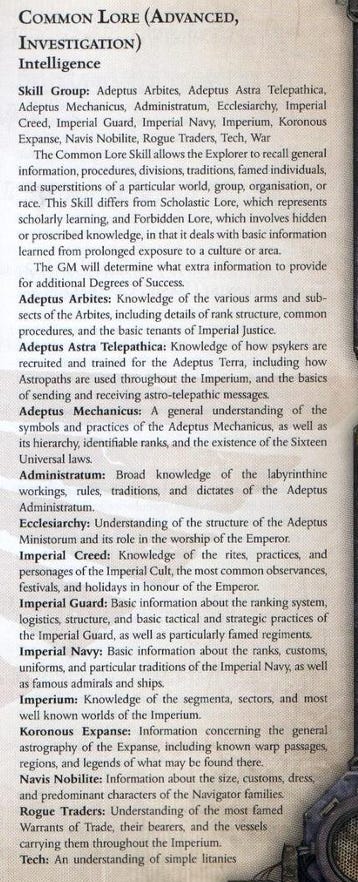
Compare this, if you will (you must), with the elegant potence of similar proficiencies from ACKS. We really don’t need to split hairs about what exact imperial institution we are trying to remember the… dress, customs or significant historical figures of. As if any of that is important to playing the game in most scenarios anyways. I really don’t understand it.
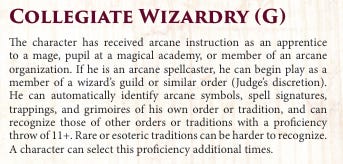
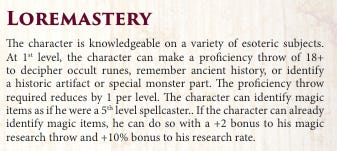
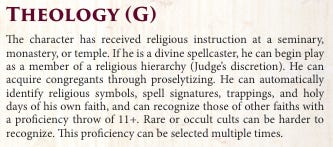
So suffice it to say, each of our eight senior officers is quite versed, or should I say somewhat versed, in a plurality of niche lore. There are other skills which are more practical, such as Dodge, and I don’t really have a bone to pick with them. The game relies on skills to regulate most actions characters take without the framework of class, and they derive from characteristics. The role skills serve is to allow a character to exceed their characteristic in a certain type of action, which I appreciate as an example of good abstraction hygiene. There is an upper limit to how “agile” you can become, but perhaps you can train your ability to dodge attacks even further, fair enough.
Some skills are basic, and can be used “untrained” at a penalty of halving the attribute they are derived from. So if someone untrained in Dodge, a basic skill, attempted to dodge they would halve their agility when determining what they need to roll. Other skills are advanced and cannot be attempted without training, which makes sense. A character completely untrained in demolition is effectively clueless at disarming a bomb. This solves the classic D&D 5-ism of “Fighter with decent intelligence score inexplicably knows alot about arcana”. I will say there are a few advanced skills which I thought should probably be basic to avoid an awkward “so you’re telling me its impossible for my character to even try this” scenario, such as Interrogation.
What advanced skills a character has access to is perhaps the largest identifier that differentiates characters of different careers at the beginning of play. There is no skill for “shooting” or “swinging a sword” its just a character’s ballistics (or weapon) skill characteristic, which like I mentioned before realistically you are + or - 5, or a 5% chance to hit, of any other character at the start of play statistically speaking. There is not a concrete “fighter, magic user, thief” sort of divide between the prime combat characteristics of individuals, which is sensible in 40k. Everyone needs to shoot lasguns.
The other point of contention for me that I uncovered during character creation was the plurality of little incremental talents. Something this system really loves is to give a character a talent or trait called “Quick Thinking” and what it does is give you a +5 to your agility stat when dodging melee attacks only. Or something like that. Take for instance the actual talent: Peer (Group). This talent gives you a +10% to fellowship checks with a certain group of people. Again, I hate to be this guy, but who freakin’ cares? No seriously? This is, at best, the type of thing the judge thinks about before making you roll reaction. “Oh well Xanatov is a techpriest in good standing, perhaps a bonus to this roll with the Magos is appropriate.” When you codify these sorts of things as character features and not systemic modifiers we are off to the ratling races frying our brains pouring over our sheets to recall every little modifier and bonus we may have for a given situation every time we roll dice. In practice, these just get ignored or forgotten. It also brings up questions about whether it is ever appropriate to give circumstantial bonuses when so many of them are otherwise baked into talents a character may or may not have. This sort of incrementalism is present with combat talents as well, which is even worse. This is a game where we’re tracking magazine capacity we do not have the overhead to remember conditionals and small bonuses.
I digress. Overall, it’s workable. An allowance of unfamiliarity must be given when working in a non-d20 system as many of us are very used to D&D and its descendant systems. This article is dragging on, so we will call it context and first impression from character creation and save my initial play tests for a part 2. Farewell until then, The Emperor Protects.
"[...] like all videogame RPGs, a story about literally 6 people travailing around to personally solve every problem in the galaxy".
LOL! So accurate!