
Investigating Rogue Trader, Part 2
In the Grim Future of the 41st Millennium there is only d100s

Last time I prattled on providing some context for why I was rooting around in a nearly 20 year old TTRPG no one plays, and gave some of my initial impressions of the system which were… mixed to say the least.
I am quite sure that some legwork will be required to engineer a solution for combat scenarios of a proper scale in this system, but before I jump off the deep end I ought to actually run a test combat and see how I feel about the rules in motion. To that end, the good Lord Captain and his Senechal will be suffering an ambush of rebellious freaks while walking the streets and corridors of a dirty hive world. I will set the scene and provide a bit of a play by play. First, we should talk a little more about what makes a man in Rogue Trader.
The Honorable Lord Captain Regias Melk
Characteristics
WS: 45
BS: 36
Strength: 42 (4)
Toughness: 32 (3)
Agility: 39 (3)
Intelligence: 46 (4)
Perception: 40 (4)
Willpower: 30 (3)
Fellowship: 47 (4)
Wounds: 8
Fate Points: 3
Equipment
Plasma Pistol
Power Sword
Best Craftmanship Stormtrooper Carapace Armor
Skills (All Trained)
Awareness
Charm
Command
Commerce
Common Lore (Imperium)
Dodge
Evaluate
Inquiry
Literacy
Scholastic Lore (Astromancy)
Sleight of Hand
Talents
Enemy (Underworld)
Paranoia
Peer (Nobility, Administratum)
Etiquette
Brook no Insult
Air of Authority
Pistol Training (Universal)
Melee Weapon Training (Universal)
Comments
Though he could stand to be a little tougher perhaps or possessed of a stiffer will, our lord captain seems to be set up to get some skull cracking done if need be. His armor grants an impressive 7 damage reduction to all locations, we will assume he is wearing it for this ambush after all hiveworlds are dangerous places for people with Enemy (Underworld).
Seneschal Marn Toole
Characteristics
WS: 23
BS: 37
Strength: 34 (3)
Toughness: 34 (3)
Agility: 44 (4)
Intelligence: 51 (5)
Perception: 41 (4)
Willpower: 33 (3)
Fellowship: 39 (3)
Wounds: 10
Fate Points: 3
Equipment
Best Craftsmanship Hellpistol
Boltgun
Xeno-Mesh Armor
Skills (All Trained)
Barter
Chem-use
Commerce
Common Lore (Underworld)
Deceive
Dodge
Evaluate
Forbidden Lore (Archaeotech)
Inquiry
Literacy
Silent Move
Talents
Technical Knock
Stranger to the Cult
Unshakable Faith
Enemy (Ecclesiarchy)
Jealous Freedom
Peer (Adeptus Mechanicus)
Pistol Training (Universal)
Basic Weapon Training (Universal)
Comments
Marn has had a bumpy path through character creation. He was born on a forge world and somehow ran aground of the Ecclesiarchy at some point. Regardless, the Seneschal career path covers some of the same skill sets as the Rogue Trader does but they seem to cut a more subtle path through conflict getting lighter armor, silent move, and ranged weapons. All the better for Marn as he doesn’t have much skill with melee weapons, strength, or toughness.
The Adversary: Scum
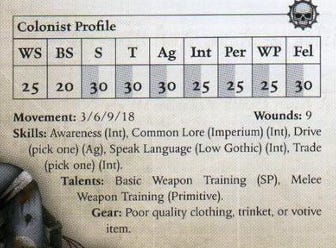
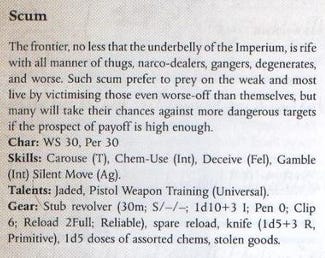
Comments
Based on the way the rulebook is laid out, I am assuming the second entry counts as a supplement for the first given that the second entry lacks a full characteristic spread. Regardless, these scum will be attempting rob the captain today. I am pleased that mathematically speaking these goons seems to represent averages from character creation, except for WS and BS.
Round 1: The Ambush
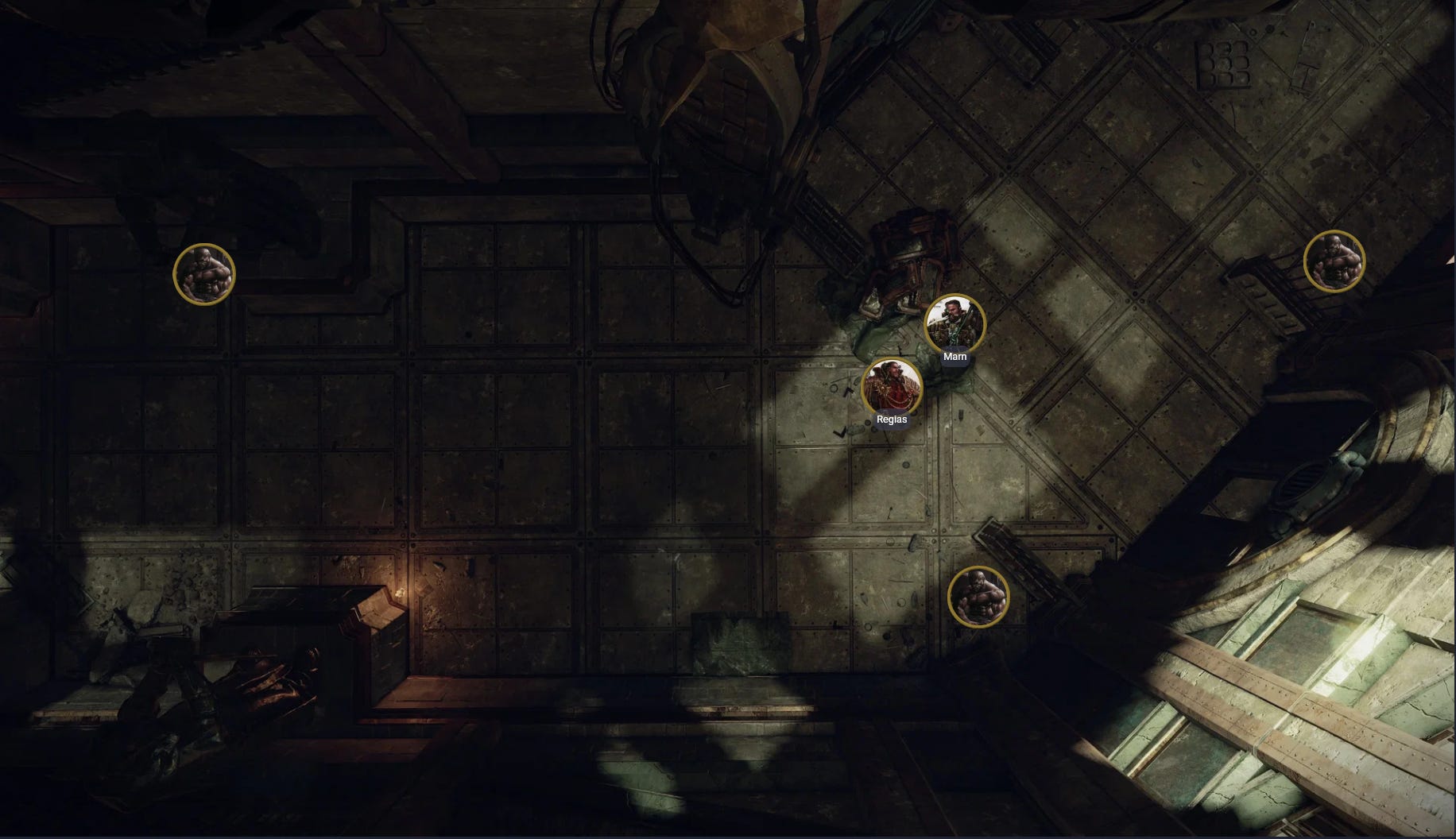
Determining Surprise: Surprise is left up to judge fiat in this game, though it suggests that you might test the would be surprisers concealment or silent move skill or some such. I don’t really like suggestions in a rulebook, but whatever. As I mentioned in the first article, we almost immediately find ourselves scanning the character sheets in search of any little talent that might be relevant here at the outset of combat. Lo and behold, the lord captain has Paranoia, which grants him a +2 initiative bonus and states “the GM may secretly Test his Perception to notice hidden threats.” Very well, the Lord Captain will test his awareness. He is trained in it so he rolls against his unmodified perception score of 40. He rolls an 85, failing by 4 degrees.
However, consulting the description of the Awareness skill, it proclaims that Awareness is always an opposed test when used against an opponent, so I suppose our adversaries must test their concealment. Concealment is a basic skill, they are not trained in it, so they are testing against 1/2 their agility which comes out to a mere 15. I will make each of the 3 scum test. One will fail by a whopping 7 degrees, which I adjudicate as losing the opposed Awareness test and giving up the ambush. I suppose we could hand out surprise by individual, but let’s say surprise isn’t a factor for this combat.
Turns Start: Initiative is individual and is equal to 1d10 + Agility Bonus + Other Bonuses. It’s a good thing the lord captain is paranoid because his +2 bonus on top of his max roll gives him top initiative against a scum who managed to roll a 10 as well. I note that having a really good agility doesn’t do a whole lot in the scheme of things here given we’re rolling d10s.
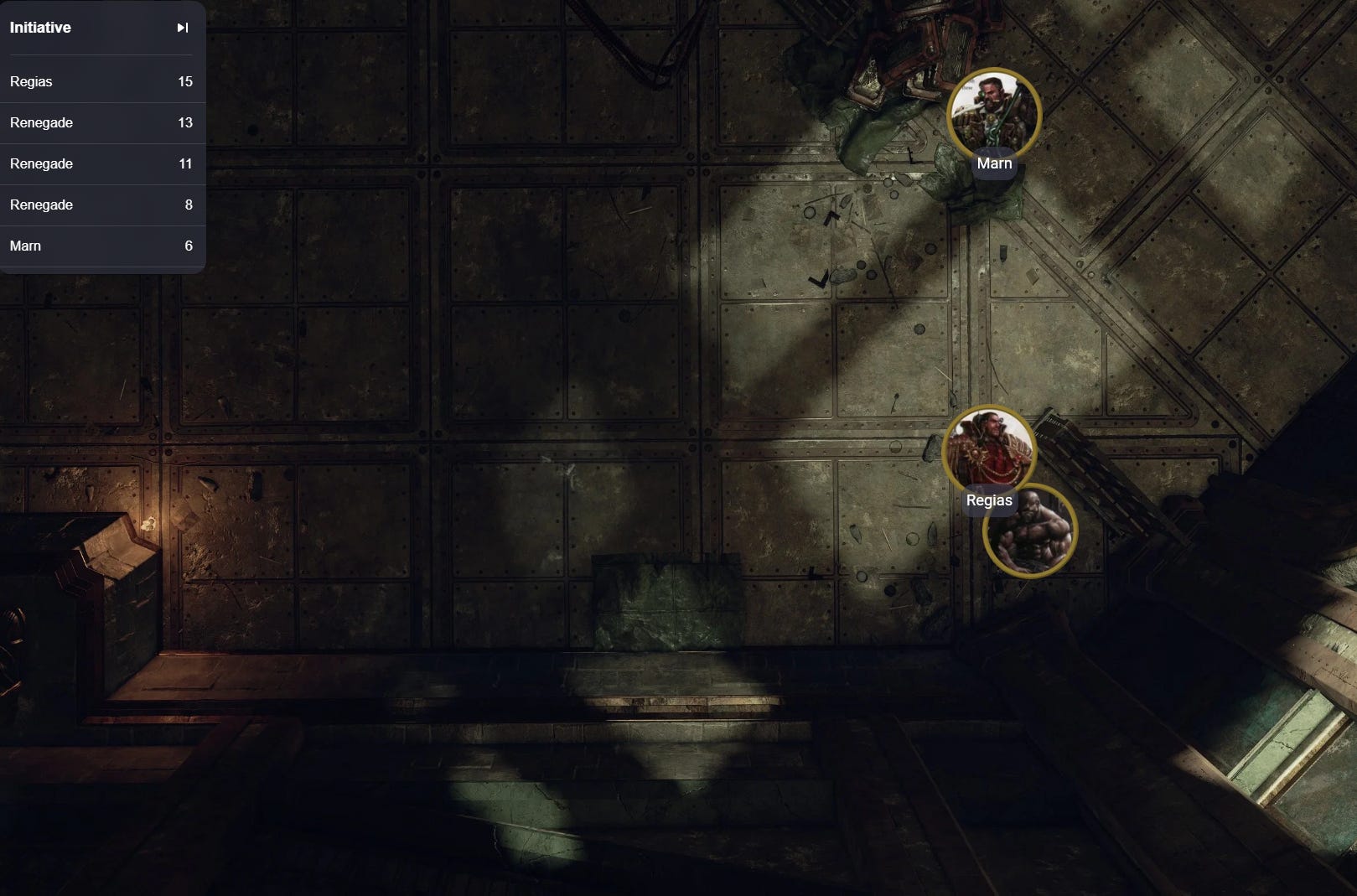
Being skilled with a power sword, the good lord captain elects to charge the closest cur who dared to assault a Rogue Trader. He charges up to 9m with his agility score of 3, which in this case is more than enough to close the distance. Charging grants a +10 to your WS for the attack, bringing the captain’s WS to 55. He rolls a 41, scoring a hit. We immediately reverse the order of the die to determine hit location, here 14 (Right Arm). The poor sap can attempt to parry or dodge, as far as I can tell the parry is more likely to succeed. Given that he is against a power weapon it is likely to destroy his knife so let us assume he dodges. He is looking for a 15 here and fails, he will suffer the hit. The good captain deals 1d10 + 5 damage with the power sword, plus his strength bonus of 4. He rolls 14 damage total. The damage is reduced by the scum’s toughness bonus of 3, resulting in 11 damage as armor is not in play. This exhausts his 9 wounds and sends him to negative 2, the critical chart is then consulted. The rulebook indicates that critical hits (which are not lethal until a character reaches around negative 8 or so wounds depending on location and damage type) can be ignored outright for insignificant enemies.
Rogue Trader, you’re losing me. Mechanics that outright only apply to player characters or other individuals on completely arbitrary (here defined as non-diegetic) terms is something I strongly dislike. Notably, choosing to consider an enemy defeated at 0 wounds instead of applying critical effects will almost half the actual effective HP of these enemies. Further, we’ve had to roll 2 d100s, 1 d10 and check 2 charts to adjudicate a single attack. It becomes clear to me within a single turn that this system is woefully inefficient. Walk with me.
Let’s assume instead that we’re resolving this turn using some mainline Warhammer rules. We can assume the Rogue Trader is WS 4 and his target is WS 2. You’ll have to forgive me, I am not up to date on my 40k editions. In mordheim (which is essentially Warhammer Fantasy 5th ed rules) its a 3+ to hit when you have higher WS, so the captain is 66% likely to hit. Assuming he is strength 4 and his target is toughness 3, that’s a 3+ to wound. A 66% of a 66% chance is 44%, essentially a 1 in 2. Compare now to RT. We had a 55% chance to hit, we needed to roll at least a 3 on the d10 for damage to get a kill. The goon had a 15% chance to dodge. That comes out to a 55% x 80% x 85% chance to empty his wounds, which we will define as a “kill”. This factors out to a 37.4% chance to kill. A 7% margin of difference. If we allow the goon to parry in the mordheim simulation he has around a ~25% chance to do so depending on the captains roll, modifying the outcome to approximately 32%, a margin of 5%. What we observe is that we can augur statistically comparable outcomes while eliminating a huge preponderance of the rules artifice. So I ask you this, “What’s the point?” I don’t have a good answer, so I stopped the combat experiment there, not even a full round. You might call me a little lazy or a little unfair, but I cannot understand why you would not just use your favorite edition of 40k to run this sort of thing instead.
The d100 system seems sensible enough on paper but doesn’t hold up to any sort of scrutiny. You might point out that mordheim also requires 3 dice rolls to resolve an attack, potentially even more if armor or parry saves are involved. What makes it a simpler system is that far fewer disparate pieces of information have to be referenced, and the info and charts that are referenced are feasible to memorize after a match or two. For example when rolling to-hit if the attacker has more WS than his opponent it is always a 3+. Otherwise it is a 4+ unless the defender has double plus one the attackers WS. That is the rule. There are no exceptions. If there is any doubt about the WS of participant models or the chart you can can always just roll the d6 first because a roll of 1,2,5, or 6 has a guaranteed outcome. The d100 system seems intuitive on it’s face, whatever your score is equals what percentage likely you are to succeed on a given action. But that’s not the case in actuality, we saw above that although the lord captain’s WS was 45, he had approximately a 37% chance to slay his target. The rulebook proscribes modifying the skill rating of a character to account for difficulty, where a +0% or flat roll is actually considered difficult which completely destroys the supposed utility of the d100 system. Compared to the elegance of d6 rolls, which we can pretty easily statistically calculate as x in 6 odds multiplied together. Needing back to back 4+ rolls is a 25% chance, back to back 3+ is a 16/36 chance, roughly 44% for the numerically literate.
Inefficient dice systems aside, rogue trader has a bigger problem. The imaginary game world of any tabletop game can be managed in one of two ways, an interconnected series of states and procedures, or a dynamic environment where rules are attached as they become relevant. “Wargames” (all RPGs are wargames but we are using the terminology of the eminent tabletop gaming zeitgeist) are strictly ordered across different phases and turns. Almost everything that happens is part of a specific procedure. We are in the movement phase, now we are in the shooting phase. We are not arbitrating discrete imaginary scenarios. This is because wargames typically deal with a stricter scope of action. Our guys are lining up to fight each other. In this way they are essentially RPGs with the other half of the game cut off. When we move between these ordered environments things get messy. Combat scenarios are very ordered in RPGs and Wargames alike because players are very invested in fairness, they don’t want to die. Rulesets lean on ordered states and procedures to keep the game moving and keep things fair, if a game cannot help but start relying on suggestions and vague arbitrage during man-to-man combat it is helpless. It’s indicative of a much more pervasive and widespread problem. Rules should endeavor to eliminate unnecessary granularity and statistics and provide structure to as broad a scope of actions as is possible. Rogue Trader seems hell bent on doing the exact opposite.
I’d be happy to be proven wrong, if any FFG Wh40k Purists are subscribed to me and wish to elucidate me to the system’s merits I’d love to hear about it in the commits, but otherwise I am out on this system. I’ll get my 40k fix elsewhere.